



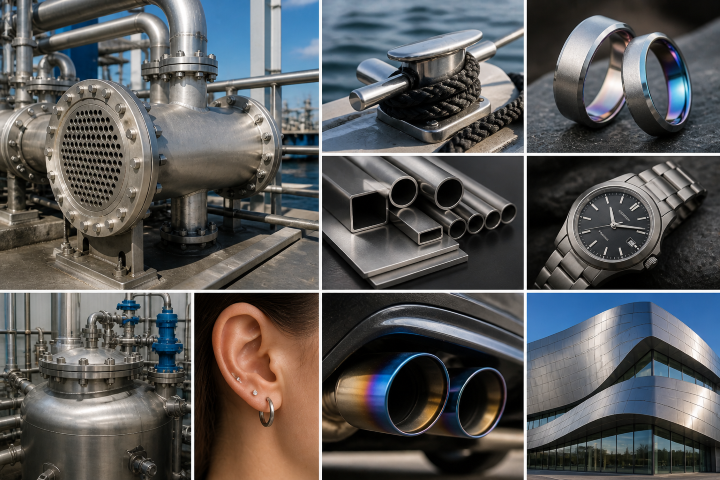
Titanium Grade 2 is a commercially pure (CP) titanium, meaning it is not alloyed with other metals. Instead, it is refined to a high level of purity, giving it consistent and reliable properties.
Among all titanium grades, Grade 2 is widely regarded as the workhorse of the industry. It offers a well-balanced combination of strength, corrosion resistance, and ease of fabrication, making it a practical choice for a wide range of applications.
Furthermore, its alpha-phase crystalline structure provides excellent stability at room temperature and contributes to its predictable performance in demanding environments.
Because of this ideal balance of properties, Titanium grade 2 is one of the most widely available and cost- effective titanium grades on the market, particularly for industrial use where reliability matters more than extreme strength.
At metals4U, we supply Titanium Grade 2 as our standard titanium grade due to its versatility and suitability for most applications.
The Key Properties of Grade 2 Titanium
Exceptional Corrosion Resistance
One of the main reasons Titanium Grade 2 is widely used is its outstanding corrosion resistance.
-
A passive oxide layer forms on its surface
-
This passive oxide layer protects the metal from the environment
-
If damaged, it self-heals instantly when exposed to oxygen
-
It is highly resistant to saltwater, chlorides, and oxidising acids
-
It outperforms many stainless steels in aggressive environments
This makes Titanium Grade 2 particularly valuable in marine and chemical applications where long-term durability is critical.
High Strength-to-Weight Ratio
Titanium Grade 2 is often chosen for projects where weight matters just as much as strength.
-
It is roughly 45% lighter than steel but offers comparable strength for many structural applications
-
It holds its performance at temperatures where aluminium can start to weaken.
-
It is useful in designs where reducing weight improves efficiency or handling.
This balance makes it a practical option in industries that need strength without the added mass.
Biocompatibility and Non-Toxic Nature
Titanium Grade 2 is renowned for its safety for use in the human body. Because it is completely nickel-free, there is a significantly reduced risk of allergic reactions. Furthermore, it is highly resistant to bodily fluids and supports osseointegration, a process that allows natural bone to bond directly with the material. Because of this, it is commonly used in medical components, implants, and body jewellery.
Grade 2 vs. Grade 5 Titanium: Which Do You Need?
Titanium Grades 2 and 5 are often compared, but they serve very different purposes.
Grade 2 is a commercially pure titanium, focused on corrosion resistance and ease of fabrication.
Grade 5, also known as Ti-6Al-4V, is an alloy developed for high strength and load-bearing performance.
Choosing the right one comes down to how the material will be used, rather than which is "better".
When to Choose Commercially Pure (Grade 2)
Titanium Grade 2 is typically the better choice when reliability, corrosion resistance, and workability are more important than maximum strength.
It is well-suited to applications where:
-
The material will be exposed to saltwater, chemicals, or harsh outdoor conditions
-
Parts need to be formed, bent, or shaped without cracking
-
Welding is required and needs to be done consistently
-
A more cost-effective solution is preferred
-
Loads are moderate rather than extreme
Because of this, Grade 2 is widely used in marine equipment, chemical processing, and general fabrication, where long-term durability matters more than raw strength.
When to Upgrade to Ti-6Al-4V (Grade 5)
Grade 5 titanium is an alloy that contains aluminium and vanadium, which significantly increases its strength.
It is used when performance requirements are much higher, particularly in demanding engineering applications.
Grade 5 is the better option when:
-
Components are subject to high stress or repeated loading
-
Strength-to-weight ratio is critical, such as in aerospace or motorsport
-
The material must maintain strength under pressure or fatigue
-
Structural performance takes priority over ease of fabrication
However, this added strength comes with compromise, Grade 5 is harder to machine, more difficult to weld, and typically more expensive.
It is worth noting that metals4U focus on supplying Titanium Grade 2, as it meets the needs of the vast majority of general engineering and fabrication applications.
Key differences between Grade 2 and Grade 5 titanium
The main difference is how each material behaves in use.
-
Grade 2 is easier to work with, more flexible, and highly resistant to corrosion
-
Grade 5 is stronger and more rigid, but less forgiving during fabrication
In simple terms, Grade 2 is often chosen for environmental resistance and versatility, while Grade 5 is selected for strength and load-bearing performance.
Comparison: Grade 2 vs Grade 5 titanium
|
Property |
Grade 2 Titanium |
Grade 5 Titanium (Ti-6Al-4V) |
|
Tensile strength |
Moderate |
High |
|
Ductility |
High (easy to form) |
Lower (more rigid) |
|
Corrosion resistance |
Excellent |
Very good |
|
Weldability |
Excellent |
More difficult |
|
Cost |
More affordable |
Higher |
A simple way to decide
If your priority is corrosion resistance, ease of fabrication, and cost, Grade 2 is usually the right choice.
If your priority is maximum strength and structural performance, Grade 5 is considered a more appropriate option.
Common Industrial Applications for CP2 Titanium
Marine and Offshore Engineering
Titanium Grade 2 performs exceptionally well in saltwater environments. It is heavily used for boat fittings, rigging, and underwater sensors. Because it resists seawater corrosion without requiring protective coatings, it offers substantial long-term cost savings by virtually eliminating maintenance and repainting.
Chemical Processing and Desalination
In highly corrosive chemical environments, Titanium Grade 2 offers long-term reliability. It is frequently used to manufacture heat exchangers, reaction vessels, and pressure tanks. It can easily withstand aggressive industrial chemicals that would rapidly corrode other standard metals.
Architectural and Decorative Uses
Beyond its industrial applications, titanium is highly valued for its aesthetic appeal. It features a natural, clean grey finish, but it can also be anodised to produce vibrant colours. This makes it a popular choice for high-end architectural cladding, decorative features, and jewellery.
High-Performance Automotive Exhausts
In motorsport and performance vehicles, weight reduction is critical. Grade 2 reduces overall vehicle weight while easily handling high exhaust temperatures. Enthusiasts also favour it because, over time, the heat creates a distinctive, highly sought-after blue-and-purple heat tint (bluing) on the metal.
Working with Titanium Grade 2: Fabrication Tips
Welding Grade 2: The Importance of Gas Shielding
Titanium reacts quickly with oxygen when heated.
-
Without protection, it becomes brittle and contaminated
-
It requires argon gas shielding during welding
-
Shielding must protect both the front and back of the weld
Careful control during welding is essential for maintaining material integrity.
Machining and Tooling Requirements
Titanium does not have the same machining qualities as more familiar metals such as mild steel or aluminium, which can make it more challenging to work with.
-
The material can feel sticky during cutting, so it does not break away into clean chips easily
-
Heat builds up in the cutting tool rather than being carried away by the material, which can lead to faster tool wear
-
Best results are achieved using sharp tools, slower cutting speeds, and steady pressure
-
A consistent flow of coolant helps control temperature and protect both the tool and the material
-
Taking a controlled approach helps produce a cleaner finish and extends tool life.
Cold Forming and Bending Capabilities
Titanium Grade 2 can be formed, but it behaves differently from steel.
-
It exhibits a high degree of ‘springback’, meaning it wants to return to its original shape after bending.
-
It requires a larger bend radius than steel
-
Proper tooling helps avoid cracking
Is Titanium Grade 2 Right for Your Project?
Titanium Grade 2 is a reliable, versatile material that performs well across a wide range of environments. It offers excellent corrosion resistance, a strong strength to weight ratio, and good formability, making it suitable for both industrial and decorative applications.
If your project requires durability, ease of fabrication, and long-term performance in challenging conditions, Titanium Grade 2 is often the practical choice.
At metals4U, we specialise in supplying Titanium Grade 2, available with a free custom cutting service, so you only pay for what you need.




Share this: