



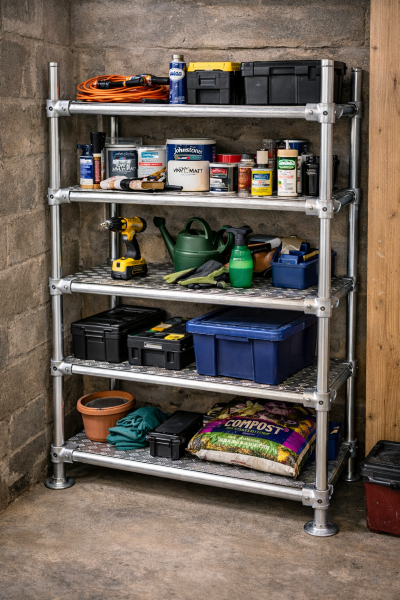
Building your own metal shelving is one of those projects that sounds more complicated than it actually is. Many assume you need an engineering degree and a welding torch, but with modern tube and key clamp systems you can put together robust, professional-grade storage with nothing more than an Allen key and a drill.
Why build your own metal shelving?
Metal shelving can go beyond just function. Besides being incredibly strong and able to hold heavy loads, it also looks great in an understated, industrial way that works anywhere from a garage to a modern kitchen.
The benefits of building your own metal shelving are:
-
Strength & Style: Industrial longevity meets modern interior design trends.
-
Customer Sizing: You can build it to fit your exact space, rather than hoping a flat-pack solution might work.
-
Modularity: Tube clamp systems are modular. Shelves can be repositioned, extended, or reduced later without needing to dismantle the entire structure.
-
Beginner Friendly: No welding is required.
-
Easy Sourcing: metals4U supplies compatible tube and fittings, often cut to length, which keeps the build straightforward.
Choosing the right materials for metal shelving
Your choice of material depends on where the shelving will be placed, the load it will hold, and the look you are trying to achieve
Tube options
Mild steel tube
-
Strong and affordable
-
Commonly used for storage, workshops, and garages
-
Can be painted or coated to protect the surface
Aluminium tube
-
Lighter than steel and easier to move during assembly
-
Naturally resistant to corrosion
-
Best suited to lighter shelving and indoor use
Stainless steel tube
-
Resists corrosion and surface marking
-
The more premium option, often selected where appearance matters as much as performance
-
Suitable for kitchens, studios, or retail settings
For heavier loads, a thicker-walled tube reduces flex and helps the frame remain square under load.
Tube Clamps
Tube clamp fittings grip onto the tube with internal screws, letting you connect everything without permanent fixings. This type of fitting means you can adjust things later if needed.
Essential fittings used for shelving include:
-
Base plates for fixing to floors or solid surfaces
-
T-connectors to support shelf rails
-
Elbow fittings for corners and end frames
Shelf surfaces
Shelves can be finished using a range of materials:
-
Timber boards or plywood for general storage
-
Aluminium sheet for hygienic areas where a harder, wipe-clean surface is needed.
-
Reclaimed timber for a less uniform finish
-
Composite panels in damp or utility areas where wood might rot
Tools and equipment you will need
The beauty of this system is the minimal tool list. Because metals4U can supply the tube pre-cut to your exact dimensions, you don't even need a hacksaw. Most builds can be completed using tools commonly found in a home or small workshop.
-
Tape measure
-
Spirit level
-
Drill with appropriate bits
-
Allen key, also known as a Hex key, for the clamps
As no welding is involved, installation can be carried out in situ without additional preparation.
Safety considerations
Working with metal and sheet materials carries basic risks. Gloves help prevent cuts from sharp edges, while eye protection should be worn when drilling or cutting. A dust mask is advisable when cutting timber boards.
Planning your shelving layout
Planning accurately will prevent the need for adjustments during installation and avoid ordering unnecessary material. A simple sketch showing dimensions, upright positions and shelf heights is usually sufficient.
Key considerations:
-
Load Capacity: Heavier loads (like engine parts or gym weights) require shorter spans between uprights to prevent the tube from bowing.
-
Freestanding vs. Fixed: Freestanding units offer flexibility, but wall-mounted units are much more stable, especially for tall builds.
-
Clearance: Measure the height of the tallest item you plan to store (e.g., plastic storage bins) and space your shelf rails accordingly.
Pro Tip: Utilise the metals4U free cutting service. Ordering your tube cut-to-size saves hours of labour and eliminates metal waste.
Step-by-step: How to build metal shelving with key clamps
1. Check tube lengths
Confirm that all tube sections match the planned dimensions. Straight, square cuts help fittings align correctly.
2. Assemble the verticals
-
Position the base plates if the shelving will be fixed to the floor
-
Insert vertical tubes into the base fittings
-
Tighten the fittings lightly to allow for any required adjustments later
3. Fit horizontal supports
-
Connect horizontal tubes using T-connectors or elbow fittings
-
Set shelf heights according to the plan
-
Use a spirit level before fully tightening the fixings
4. Install the shelves
-
Lay timber boards or aluminium sheet onto the horizontal rails
-
Fix in place using the appropriate fasteners
-
Ensure the full depth of each shelf is supported, and there is no sagging
5. Secure and check
-
Check the structure is level
-
Tighten all fittings evenly
-
Fix to a wall if required, particularly for taller units
When loading shelves, spread the weight across the surface rather than concentrating it in one area.
Finishing options – make it durable or stylish
The final finish affects both durability and appearance.
Options include:
-
Painting or powder coating a mild steel tube to prevent corrosion
-
Leave stainless steel exposed (it will look after itself)
-
Edge trim on timber shelves to protect the corners from damage
-
Apply non-slip coatings on workshop shelving
-
Fitting castors to the base to allow the shelving to be moved
Example shelving ideas for inspiration
This construction method provides excellent versatility and can be adapted for many different settings.
Common uses include:
-
Garage shelving for tools and equipment
-
Workshop storage for parts and consumables
-
Kitchen or utility shelving with an industrial look
-
Living room shelving combined with timber boards
-
Retail or studio display units
Common questions answered
How much weight can metal shelving take?
Capacity depends on tube size, wall thickness, clamp selection, and shelf span. A standard 33.7mm or 42.4mm steel tube is incredibly strong. As long as the weight is spread evenly, the shelving can support heavy loads.
What tube diameter should be used?
A greater tube diameter and thicker walls mean more strength. For general use, medium diameter, 33.7mm or 42.4mm, works fine. If you are storing engine blocks or bags of cement, go with a thicker material and step up to 48.3mm diameter.
Can shelving be fixed to a wall?
Absolutely, wall fixings improve stability and are recommended for tall or heavily loaded structures.
Will it work outdoors?
Stainless steel and aluminium withstand outdoor conditions brilliantly. Mild steel will need protecting with an appropriate coating if exposed to moisture.
Build strong, long-lasting shelving with metals4U
metals4U stocks everything you need - tube cut to your exact lengths, all the tube clamp fittings, and aluminium sheet for surfaces. The free cutting service means you only pay for what you use, with no waste.
The modular design lets you start with a basic setup and expand later. Add more shelves, extend sideways, and stack another tier on top. It grows with your needs rather than becoming obsolete. Alternatively start with metals4U complete tube clamp kits for faster installation
Build something that fits your space perfectly and looks great. Shop tube and tube clamps now.




Share this: